Are parents struggling to keep fitness consistent because the house is too small, schedules are packed, or children require constant supervision? Practical, progressive home gym programs can deliver measurable fitness gains while fitting into a closet, corner, or playroom. This guide presents actionable, space-first programs and quick routines designed specifically for busy, space-constrained parents.
Key takeaways: what to know in 1 minute
- Short, progressive programs win. Modular 10–20 minute sessions conducted 3–5 times weekly provide sustainable results for parents with limited space.
- Two-zone strategy prevents compromise. A movable workout zone (rug + mat) and a storage zone (under-bed or closet) allow rapid transitions between family time and training time.
- Equipment is optional. Bodyweight and band-based plans match or exceed outcomes of bulky setups when programmed progressively.
- Safety and childproofing are essential. Store equipment securely and use barriers or supervision during sets.
- Cost scales with intent. Expect a basic space-saving setup for $50–$200 and a compact, durable kit for $200–$700.
Why home gym programs for space-constrained parents are different
Parents in tight spaces require programs that prioritize (1) minimal footprint, (2) short high-quality sessions, (3) easy storage, (4) safety with children present, and (5) scalability across fitness levels. Typical gym plans assume equipment and uninterrupted time; space-constrained parent programs reverse those assumptions and embed flexibility into progression. Research on time-efficient training supports short, frequent sessions as effective for improving cardiovascular and strength markers when intensity and progression are preserved (see CDC physical activity recommendations).
Space-friendly beginner home workouts for parents: a progressive 12-week plan
This 12-week program is structured in three 4-week blocks. Workouts are 12–20 minutes, 3–5 times per week. Each block adds intensity or complexity while keeping the equipment footprint minimal.
Block A (weeks 1–4): foundation
- Frequency: 3 sessions/week, 12–15 minutes per session.
- Focus: mobility, movement quality, basic strength.
- Example session: 30s march in place, 10 bodyweight squats, 8-10 incline push-ups (on sofa), 30s plank, repeat circuit 2–3 times.
Block B (weeks 5–8): capacity
- Frequency: 4 sessions/week, 15–20 minutes.
- Focus: moderate intensity, introducing resistance bands or small dumbbells.
- Example session: band deadlift x12, single-leg box step-up x8/leg, band row x12, 40s AMRAP core. 3 rounds.
Block C (weeks 9–12): strength & efficiency
- Frequency: 4–5 sessions/week, 15–20 minutes.
- Focus: heavier resistance (heavier bands or 10–20 lb dumbbells), short intervals for conditioning.
- Example session: goblet squat x10, reverse lunge x8/leg, push-up progression x8-12, 20s hard cardio + 40s rest x6.
Progression principle: when a set becomes manageable, increase repetitions, reduce rest, add resistance, or replace with a harder variation. Keep training logs in a phone note or simple printed tracker.
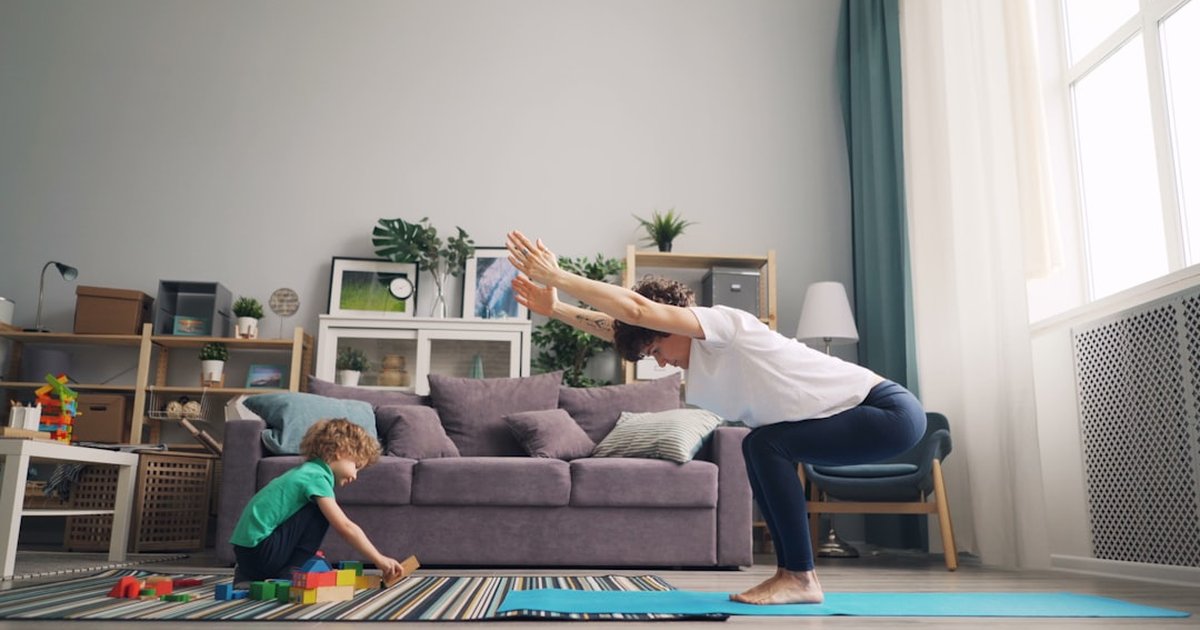
Adapted living room workout step by step
This step-by-step routine turns an ordinary living room into a safe, effective training zone in under 60 seconds.
Move lightweight toys, place a non-slip mat, and identify a nearby chair or sofa for support. Storage tip: use a collapsible bin to move toys temporarily.
Step 2: set a timer and remove distractions
Use a 12–20 minute timer (phone on Do Not Disturb). If children nap or play nearby, use visual cues like a small sign: "Short workout — stay close" to signal caregivers.
Step 3: warm up dynamically (2–3 minutes)
Arm circles, hip hinges, marching in place with knee lifts. Keep movement controlled and joint-focused.
Step 4: perform the main circuit (8–15 minutes)
Superset strength and mobility: 45s work / 15s transition or 30s work / 30s rest. Examples: chair-assisted squats, band rows, glute bridges, incline push-ups, lateral lunges.
Step 5: short cool-down and child-friendly transition (1–2 minutes)
Light stretches and a quick tidy of the workout zone to make space for play. Reward the child with praise or a sticker for safety adherence.
Best space-adapted compact equipment for playrooms
A curated list of compact gear that fits playrooms or closets. Prioritize multiuse items and safe storage.
| Item |
footprint |
typical cost |
best use case |
| Resistance bands (set) |
small pouch |
$15–$40 |
full-body strength, progressive load |
| Door anchor + bands |
straps only |
$10–$25 |
rows, presses using door frames |
| Adjustable ankle/wrist weights |
tiny bag |
$20–$60 |
added load for bodyweight moves |
| 8–20 lb adjustable dumbbells (compact) |
shelf-sized |
$150–$300 |
progressive strength without rack |
| Foldable yoga mat |
rolls up |
$15–$45 |
cushioning, defined zone |
| Collapsible plyo box / step |
thin when stored |
$80–$180 |
step-ups, box squats (choose soft edges for playroom) |
All items above can be stored vertically behind a door, under a bed, or inside a closet. Anchoring rules: secure heavy items low and out of children's reach.
Simple adaptive guide to equipment-free parent workouts
Equipment-free training remains the most space-efficient approach. Focus on leverage, tempo, and unilateral work to create progressive overload.
- Use tempo control: slow eccentric phases increase workload without added equipment.
- Increase range of motion: deeper squats or elevated single-leg work add difficulty.
- Add density: reduce rest time or add rounds to progress capacity.
Sample 10-minute equipment-free sequence (AMRAP or rounds):
- 10–12 squats (air)
- 8–10 push-ups (incline if needed)
- 8–10 reverse lunges per leg
- 30s plank
- Repeat for 2–4 rounds based on time
Safety tips for equipment-free sessions
- Prioritize joint alignment over repetitions.
- Keep workout zone away from furniture sharp edges.
- When a child interrupts, stop and resume the set rather than pushing through compromised form.
Space-saving home gym cost for busy parents: budgeting and real examples
Budget tiers for a functional, compact home gym that suits parents in tight spaces.
- Basic ($50–$200): resistance bands set, foldable mat, door anchor, small storage bin. Ideal for beginners and budget-conscious parents.
- Moderate ($200–$500): adds compact adjustable dumbbells or kettlebell, collapsible step. Good for sustained progressive loading.
- Premium compact ($500–$900): high-quality adjustable weights, soft plyo box, dedicated wall rack (if space allows). Best for long-term commitment.
Cost per month perspective: amortizing a $300 kit over 24 months equals $12.50/month — typically less than a monthly gym membership and without travel time.
Compact layout templates for typical small spaces
- Living room corner (recommended): 6x6 foot rug, mat, storage ottoman for equipment. When not training, ottoman functions as seating and holds bands and small weights.
- Hallway closet conversion: install removable shelf with bins; use fold-down mat in doorway for workouts.
- Playroom shared zone: anchor large toys to walls and dedicate a safe mat area near supervision.
Storage, childproofing and safety checklist
- Store heavy items low and locked away.
- Use soft-edge equipment or pad sharp corners.
- Keep resistance bands out of reach of very young children when not in use.
- Supervise or schedule workouts during naps or partner support windows.
Compact routine workflow
Compact routine workflow
👟
Step 1: Clear 6x6 zone
Move toys, roll mat, set timer
⏱️
Step 2: 2–3 min warm-up
Dynamic mobility to prepare joints
⚡
Step 3: 8–15 min main circuit
Strength + short cardio bursts
✅
Step 4: Quick cool-down & tidy
Stretch, store gear, return to parenting
Benefits, risks and common mistakes
✅ Benefits / when to apply
- Time-efficient conditioning while maintaining family responsibilities.
- Scalable strength improvements without large equipment.
- Increased consistency: shorter, approachable sessions are easier to maintain.
⚠️ Errors to avoid / risks
- Using poor form to rush sets (injury risk).
- Leaving equipment accessible to unsupervised children.
- Expecting rapid body recomposition without dietary or sleep adjustments.
Corrective actions
- Use conservative progression and maintain technique.
- Store all gear in childproof containers or high shelves.
- Track progress with simple metrics: sets, reps, resistance, perceived exertion.
Evidence and expert resources
Frequently asked questions
How long should a home gym session be for busy parents?
Most effective sessions are 10–20 minutes when programmed with clear intensity and progression. Shorter, consistent sessions beat sporadic long workouts.
Can progress be achieved without weights in a small space?
Yes. Progression through tempo, volume, unilateral variations, and density reliably increases strength and fitness without traditional weights.
What is the safest way to store equipment with small children?
Store heavy items low in a locked cabinet and soft items in bins; keep bands and straps out of reach to avoid entanglement hazards.
How much does a compact home gym cost?
Expect a basic setup for $50–$200, a durable mid-tier kit for $200–$500, and premium compact systems up to $900 depending on build quality.
Which exercises work best in a living room setting?
Squats, lunges, push-up progressions, band rows, glute bridges, and short cardio bursts are ideal—these require minimal clearance.
How to exercise safely after childbirth in a small space?
Follow postnatal screening, start with foundational core and pelvic-floor work, and consult guidance from relevant medical bodies like the ACOG before intense training.
Are 10-minute micro-workouts actually effective?
Yes—when intensity, movement selection, and progressive overload are preserved, micro-workouts improve strength and metabolic fitness over time.
Conclusion
Next steps
- Choose one 10–20 minute module from the 12-week plan and schedule it three times this week. Use a calendar block the same way a meeting would be scheduled.
- Buy one compact item (resistance band set or foldable mat) and create a dedicated 6x6 foot workout zone that stores easily when not in use.
- Implement one safety action: secure heavy gear and create a simple visual cue for household members indicating a short workout is in progress.
